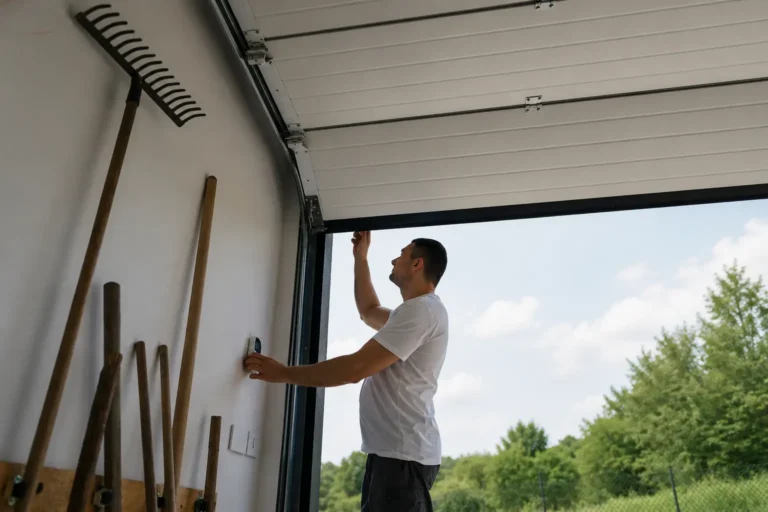
It is 6:40 on a Tuesday morning in Canton. You hit the remote, the opener groans, and the door moves three inches and stops. You are stuck. Work starts in an hour, the kids need school drop-off, and the car is locked inside the garage.
This is one of the most common opener problems homeowners run into. And here is the good news: most opener problems are fixable the same day, often in under ninety minutes, without replacing the whole unit.
This guide covers everything a Canton homeowner needs to know about garage door opener problems: the warning signs, the opener types, the brands, honest repair-vs-replace advice, and safe DIY fixes.
Need help right now instead of reading? Our garage door opener repair service in Canton, GA offers same-day repairs — most fixed in under 90 minutes. Call (770) 828-8811.
Quick Answer: Why Is My Garage Door Opener Not Working?
Most common causes: safety sensors out of alignment, a dead remote battery, no power to the opener, or a stripped drive gear.
Start here: (1) Check that the opener has power — plug a phone charger into the outlet. (2) Look at the sensor lights near the floor on both sides of the door — both should be solid, not blinking. (3) Try the wall button — if it works but the remote does not, the problem is the remote, not the motor. (4) If the motor hums but the door does not move, stop using it and read the stripped-gear section below.
If the door feels heavy when lifted by hand, or it hangs crooked, stop using the opener immediately — that signals a broken spring or cable. That is a garage door spring repair or garage door cable repair job, not an opener job.
Table of Contents
- Garage Door Opener Not Working
- Opener Reverses Before Closing
- Remote Not Working
- Opener Hums But Door Doesn’t Move
- Opener Stopped Working After a Storm
- Opener Making Grinding or Squealing Noises
- Opener Light Blinking or Beeping
- Door Closes Then Reopens
- Emergency Release Handle Disengaged
- Wall Console Lock / Vacation Mode
- Power Outlet or GFCI Trip
- Travel / Limit Settings Off
- What Types of Garage Door Openers Are There?
- Which Opener Brands Are Common in Canton, GA?
- Should I Repair or Replace My Garage Door Opener?
- How Much Does Opener Repair Cost in Canton, GA?
- Can I Fix My Garage Door Opener Myself?
- Frequently Asked Questions
Troubleshooting: Find Your Symptom
Garage Door Opener Not Working
Cause: The opener is getting no power, the wall console is in lock mode, or the motor/logic board has failed.
Quick fix: First confirm power — plug a lamp or phone charger into the opener’s outlet. Check the breaker and any GFCI outlet in the garage (see Power Outlet or GFCI Trip). Then check the wall console for a lock or vacation-mode light (see Wall Console Lock / Vacation Mode). If the wall button works but nothing else does, the issue is the remote or receiver, not the motor.
Call a pro if: the outlet has power, the lock is off, and the opener still does nothing — the logic board or motor may need replacement. For full service detail, see our garage door opener repair service in Canton, GA.
Opener Reverses Before Closing
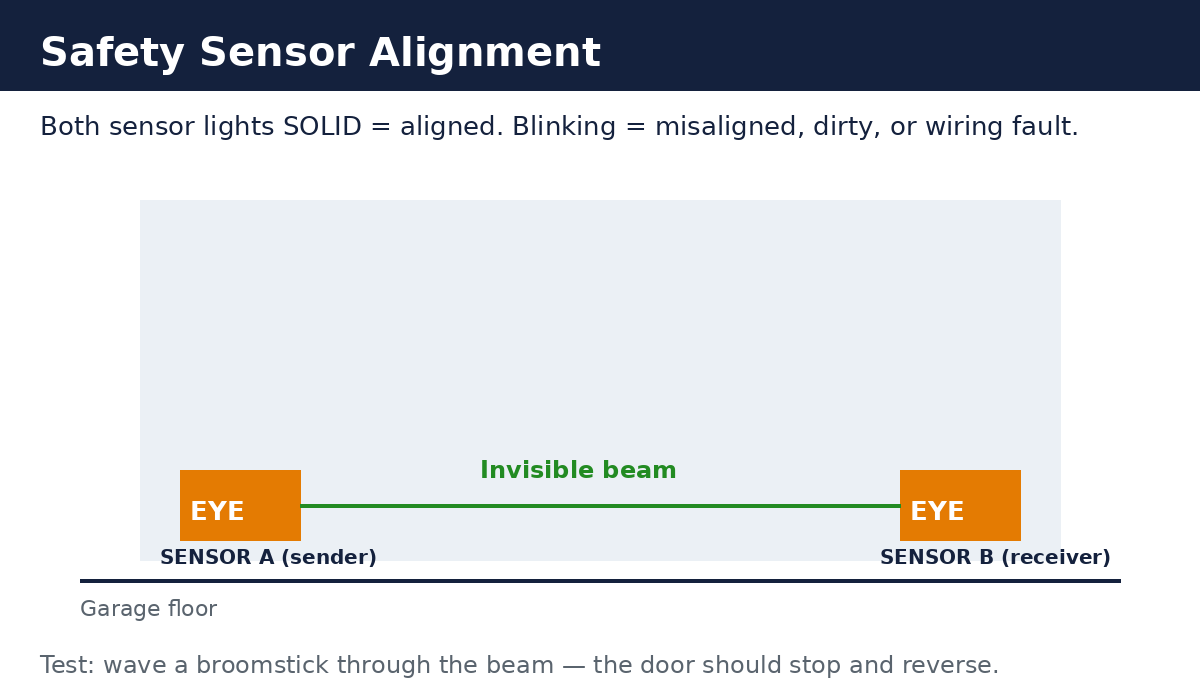
Cause: Most often, the safety sensors are the culprit. These are the two small “eyes” near the floor on each side of the door. Georgia dust, spiderwebs, or a bumped bracket knocks them out of alignment.
Quick fix: Check that both sensor lights are solid, not blinking. Wipe the lenses, and gently realign a bumped bracket until both lights hold steady. Test: close the door with the remote, then wave a broomstick through the invisible beam between the two sensors near the floor — the door should stop and reverse immediately. If it keeps closing, the sensors are misaligned, dirty, or dead. Safety sensors and auto-reverse are among the safety features required under federal safety rules (CPSC, which reference UL 325).
Call a pro if: the sensors look aligned and clean but the door still reverses — the force or limit settings, or the sensor wiring, may need a technician.
Remote Not Working
Cause: Usually a dead battery, signal interference, or a remote that lost its programming.
Quick fix: Start with a fresh battery. If that does not help, check for LED bulbs installed in the opener — they are a real and surprisingly common source of signal interference. Try reprogramming the remote with the “learn” button on the opener unit (follow your model’s manual). If the wall button works but the remote does not, the problem is the remote or receiver, not the motor — one of the quickest and least expensive fixes.
Call a pro if: a new battery and reprogramming do not help — the receiver or logic board may be failing.
Opener Hums But Door Doesn’t Move
Cause: The classic stripped drive gear. The motor runs, but the gear that drives the chain or belt has worn down to nubs, and nothing moves. It is the most common internal failure in older openers.
Quick fix: There is no safe DIY fix for this one — stop running the opener, because the motor will keep spinning against a stripped gear. Note whether the hum comes with any movement at all, and whether the door lifts easily by hand (with the release pulled). That tells a technician whether it is the gear alone or a door-balance problem too.
Call a pro if: this is your symptom — gear replacement is a standard technician job and very repairable.
Opener Stopped Working After a Storm
Cause: Summer thunderstorms around Cherokee County send power surges through garage outlets, and opener circuit boards are sensitive. If your opener died right after a storm, the board likely took the hit.
Quick fix: Check the outlet and breaker first. If the opener is completely dead, the board may need replacement. A fifteen-dollar surge protector on the opener outlet prevents most of this. Battery-backup smart openers keep working through outages too — worth considering if your area loses power often.
Call a pro if: the opener is dead after a storm or the board shows burn marks — board replacement is a technician job.
Opener Making Grinding or Squealing Noises
Cause: A healthy opener hums. Grinding means worn gears. Rattling means a loose chain or mounting hardware. Squealing points to dry rollers or bearings.
Quick fix: Tighten any visibly loose mounting hardware and check the chain tension if your model allows it. A light silicone-based lubricant on the chain once a year helps (never regular WD-40, which attracts dust).
Call a pro if: noise gets worse over a few weeks — that is your opener telling you a part is wearing out. Catch it early and you pay for a repair; ignore it and you pay for a replacement.
Opener Light Blinking or Beeping (Blink Codes)
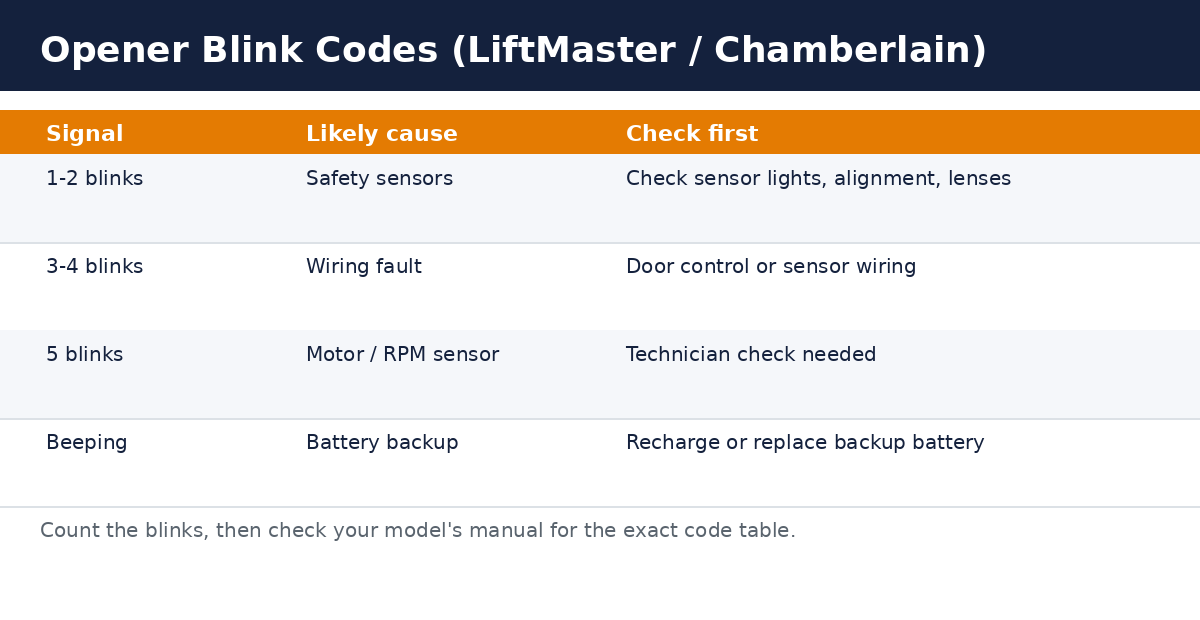
Cause: On LiftMaster and Chamberlain openers, the light blinks are diagnostic codes. One or two blinks usually point to the safety sensors (misaligned, dirty, or a wiring fault). Five blinks often point to the motor or RPM sensor. Beeping usually means the battery backup needs attention or the unit lost power.
Quick fix: Count the blinks, then check the sensor lights and alignment first — that clears most 1–2 blink cases. For beeping, check whether the opener is running on battery backup and recharge or replace the backup battery. Your model’s manual lists the full blink-code table.
Call a pro if: the code keeps returning after you check the sensors, or the opener shows 5+ blinks — that points to a motor or board fault.
Door Closes Then Reopens
Cause: The door travels all the way down, then immediately goes back up. This usually means the close-limit setting is slightly off (the opener thinks the door hit an obstruction), the force setting is too sensitive, or something on the floor is breaking the sensor beam at the last moment.
Quick fix: Clear the doorway and check the sensor lights. If the floor is clear and the sensors are aligned, the close-limit or force setting may need a small adjustment — follow your model’s manual for the limit screws, and adjust in small steps.
Call a pro if: adjusting the limit does not hold, or the door slams and then reopens — the door may be out of balance or the rail may be binding.
Emergency Release Handle Disengaged
Cause: The red emergency release cord was pulled (often during a power outage), which disconnects the door from the opener trolley. The opener runs, but the door stays put.
Quick fix: To re-engage, pull the red cord handle toward the door (toward the “engage” position on most models), then run the opener — the trolley should click back onto the carriage when it passes it. Or, with the door closed, pull the cord down and toward the door, then lift the door by hand a short distance until it locks back on.
Call a pro if: the trolley will not re-engage, or the door feels heavy or crooked when lifted by hand — that signals a spring or cable problem, not an opener problem.
Wall Console Lock / Vacation Mode
Cause: Many wall consoles have a lock or vacation button that disables the remotes while the wall button still works. It is easy to press by accident when wiping the console or when kids reach it.
Quick fix: Look for a lock, vacation, or padlock symbol on the wall console. Press and hold the lock button for a few seconds until the indicator light turns off, then test the remote. On some models the lock is a sliding switch on the console.
Call a pro if: the lock light will not clear or the remotes stay dead after unlocking — the console wiring or receiver may be at fault.
Power Outlet or GFCI Trip
Cause: The opener is not getting power — a tripped GFCI outlet, a tripped breaker, or a loose plug.
Quick fix: Plug a lamp or phone charger into the opener’s outlet. If it does not charge, press the RESET button on the GFCI outlet (usually on the garage wall, often with TEST/RESET buttons), then check the breaker panel. Make sure the opener’s plug is fully seated — vibration can work it loose over time.
Call a pro if: the outlet has power but the opener is still dead, or the GFCI trips again immediately — that points to a wiring or board fault.
Travel / Limit Settings Off
Cause: The travel (limit) settings tell the opener how far to run in each direction. If they drift, the door may stop a few inches short of the floor, not open all the way, or reverse for no clear reason.
Quick fix: Check the sensor alignment and the doorway first — most “limit” problems are really sensor problems. If those are clear, adjust the travel screws on the opener unit in small steps per your model’s manual, testing after each turn. Do not crank the force setting up to compensate — that defeats the safety reverse.
Call a pro if: the settings will not hold, or the door binds or slams — the rails, rollers, or door balance may need attention.
What Types of Garage Door Openers Are There?
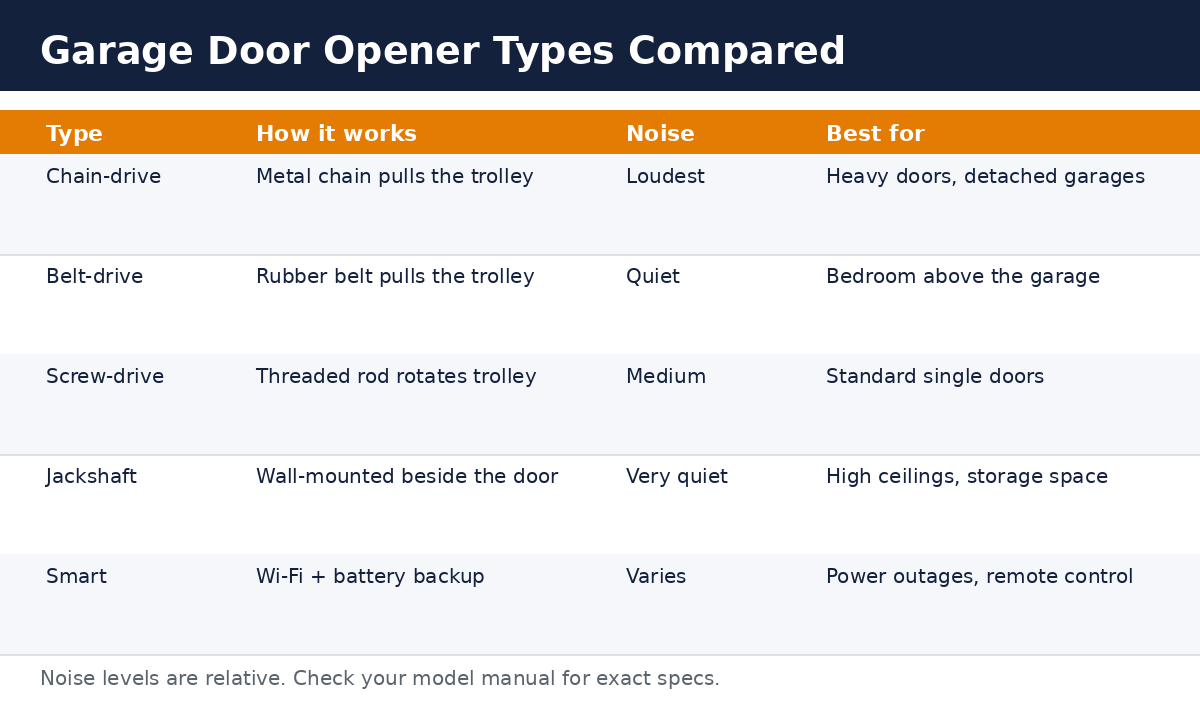
Canton homes have all five types. Knowing which one you have helps you describe the problem when you call. One local quirk first: Georgia heat. Metal rails and chains expand past 90°F, and older logic boards get heat-sensitive — an opener that works at 8 AM but acts up at 3 PM in summer is a classic heat-expansion symptom.
Chain-drive openers — the workhorse. A metal chain pulls the trolley that moves the door. They are affordable, strong enough for heavy double doors, and last for years. The trade-off is noise. They suit detached garages well. They are a poor pick when a bedroom sits directly above the garage.
Belt-drive openers — the quiet upgrade. A reinforced rubber belt replaces the chain, so the door glides with far less noise. Most Canton homeowners with a bedroom or home office above the garage choose belt drive when replacing. It costs more than chain drive. The quiet is worth it.
Screw-drive openers — a threaded steel rod rotates to move the trolley. Fewer moving parts means less routine maintenance, and they handle Georgia’s temperature swings well. They suit standard single doors best and run louder than belt drives.
Jackshaft (wall-mount) openers mount on the wall beside the door instead of the ceiling. They free up overhead space, which matters in garages with high ceilings, storage racks, or car lifts. They run very quietly and look clean. They cost more upfront.
Smart openers add Wi-Fi, smartphone control, and battery backup. Your door keeps working during a power outage, and you can check whether you left it open from anywhere. We install new smart units and can add smart controllers to many existing openers.
Not sure which type you have? Open the garage and look at the rail above the door. A chain looks like a bicycle chain. A belt looks like a thick black strap. A threaded rod means screw drive. A box on the wall beside the door means jackshaft.
Which Opener Brands Are Common in Canton, GA?
We service the major opener brands found in American homes — LiftMaster, Chamberlain, Genie, and older Craftsman models. Many Craftsman units were built by Chamberlain, so compatible parts are sometimes available for older units, depending on the model and its condition.
LiftMaster dominates the pro-installed market with the widest parts availability. Chamberlain owns the DIY retail shelves and shares most of its engineering with LiftMaster. Genie is common in older Canton subdivisions, and its screw-drive models are still running strong after twenty years.
Security note: older openers (many from the 1990s) used fixed codes that a neighbor’s remote could theoretically trigger. Modern rolling-code openers change the code with every press, making that practically impossible.
When you call a pro, tell them the brand and approximate age. That one detail lets them load the right gear, sensor, or logic board on the truck before rolling. For repair options by brand, see our garage door opener repair service in Canton, GA.
Should I Repair or Replace My Garage Door Opener?
Here is the honest answer most pros will give you.
Repair it when the opener is under ten years old, the problem is a single part (gear, sensor, remote, capacitor), and the door itself is balanced and in good shape. Most single-part repairs cost a fraction of a new unit and add years of life.
Replace it when the opener is twelve to fifteen years old or more, parts are discontinued, it lacks modern safety sensors, or you have already paid for two repairs in the last year. At that point you are feeding a dying machine. A new belt-drive opener with battery backup and smartphone control pays for itself in reliability and quiet, especially if your household cycles the door four or more times a day.
The gray zone is a ten-to-twelve-year-old opener with one failed part. If the door is balanced, the rails are straight, and everything else is healthy, a repair is the smart money. If the whole system is tired, replacement saves you a second service call six months later. A good technician will tell you straight.
For the full service view — what a visit includes and how pricing works — see our garage door opener repair service in Canton, GA.
How Much Does Opener Repair Cost in Canton, GA?
Opener repair costs vary with the model and the problem, so an accurate quote usually requires an inspection. A reliable technician should explain the issue and provide clear pricing before starting the work.
For estimated prices for opener repairs, springs, cables, and full replacements, check our garage door repair cost guide for Canton, GA. If your garage door is stuck and you need urgent help, our 24/7 emergency garage door repair service serves Canton and Cherokee County.
Can I Fix My Garage Door Opener Myself?
Some of it, yes. Safe DIY territory: replacing remote batteries, realigning safety sensors, reprogramming a keypad with the “learn” button, checking whether the outlet has power, and a light silicone-based lubricant on the chain once a year (never regular WD-40, which attracts dust). These solve a large share of “my opener stopped working” calls and cost nothing.
Draw the line at anything involving the door’s lifting hardware. Springs, cables, and track work are not DIY. A standard double door weighs over 150 pounds, and the torsion springs that counterbalance it sit under extreme tension. If your door feels heavy, hangs crooked, or the opener strains and groans, stop using it and call a pro.
For anything beyond the basics, a local pro will tell you honestly whether it is a five-minute fix or a technician visit — and remember most companies service the whole system, not just the box on the ceiling: springs, cables, rollers, panels, and full garage door installation too.
Frequently Asked Questions
Need help right now?
24 hours a day, 7 days a week. Call now for immediate dispatch.